AirTAC upholds the principle of resource recycling and establishes an appropriate environmental management system in compliance with applicable environmental laws, regulations, and relevant international standards to properly protect the natural environment. The Company is also committed to achieving environmental sustainability in its operational activities and internal management.
|
Environment Strategy |
Implementation Description |
|
Environmental Regulation Compliance |
Continue to monitor the development of environmental regulations in various countries, update and implement internal operating procedures accordingly. Periodic regulatory compliance training sessions are also provided and incorporated into the Company's annual internal training program. |
|
Improving the Efficiency of Resource Utilization |
Enhance resource efficiency by prioritizing the use of low-impact recycled materials, promoting resource circulation and sustainable utilization. |
|
Establish an Environmental Management System |
● Following the ISO 14001 environmental management system framework, a comprehensive environmental management system has been established to systematically manage the impacts of operational activities on the natural environment.
● Collect sufficient and timely information and assess the impacts of operational activities on the natural environment.
● Set measurable environmental sustainability goals and periodically review their ongoing progress and relevance.
● Develop specific plans or action programs as implementation measures, and regularly review their effectiveness. |
|
Establish a Dedicated Environmental Management Unit and Appoint Responsible Personnel |
● Formulate, implement, and maintain relevant environmental management systems and specific action plans.
●Coordinate the implementation of environmental management measures across all operational sites, consolidate environmental performance, and promote continuous improvement.
● Conduct regular environmental education programs for management and employees. |
|
Consider the Ecological Impact of Operations |
Reduce the impact of the Company’s operations on the natural environment and human health:
● Minimize resource and energy consumption in products and services.
● Reduce emissions of pollutants, hazardous substances, and waste, and ensure proper waste management.
● Enhance the recyclability and reuse of raw materials and products.
● Promote the sustainable use of renewable resources to the greatest extent.
● Extend product durability.
● Improve the efficiency and performance of products and services. |
|
Improve Water Use Efficiency |
● Establish relevant management measures to improve water use efficiency and ensure proper utilization of water resources.
● Establish and continuously strengthen wastewater treatment and monitoring facilities to ensure that discharged water meets regulatory standards and minimizes environmental impact.
● Promote circular and sustainable water use by implementing rainwater harvesting, process water reuse, and water quality monitoring mechanisms to achieve effective water resource recycling. |
|
Assess Potential Risks and Opportunities of Climate Change |
● Conduct climate-related assessments and responses in accordance with international standards, such as the Task Force on Climate-related Financial Disclosures (TCFD).
● Regularly identify potential climate-related transition risks (such as policies, regulations, carbon pricing, and energy costs) and physical risks (such as extreme weather, supply chain disruptions, and water resource risks), and assess opportunities including investments in energy-efficient equipment, renewable energy, and green manufacturing processes. |
Waste Management
AirTAC upholds the principle of resource recycling and is committed to minimizing waste at the source and effectively segregating waste. By continuously increasing the recycling rate, the Company implements the concept of zero-waste manufacturing.

I.Goals and Strategies
AirTAC adopts proactive waste-reduction measures to minimize waste generation and increase the reuse rate of waste materials. By establishing concrete short, medium, and long-term targets and action plans, and tracking progress accordingly, the company is committed to advancing circular economy practices.
|
Goals and Strategies |
2024
Performance Achievements |
2026 Goals and Corresponding Strategies |
2036 Goals and Corresponding Strategies |
|
Waste
Management |
● In 2024, AirTAC's waste intensity (waste generated per NT$1 million in sales) was 0.68, a 15% reduction from 2021.
● In 2024, AirTAC's hazardous waste intensity (hazardous waste generated per NT$1 million in sales)was 0.18, a 10% reduction from 2021. |
Target:
Compared with 2021, waste intensity decreased by 17%, and hazardous waste intensity decreased by 12%. |
Target:
Compared with 2021, waste intensity decreased by 30%, hazardous waste intensity decreased by 20%, and the waste recycling and reuse rate exceeded 97%. |
|
Strategies:
● Reduce waste at the source by adjusting production processes to lower raw material usage and minimize overall waste generation.
● Purchase new equipment, such as oil–water separators, to reduce the generation of hazardous waste, including cutting fluids.
● Increase the recycling and reuse of both internal and external packaging materials to continuously improve the waste reuse rate. |
Strategies:
Actively innovate recycling and reuse technologies to expand the conversion of waste liquids into valuable recycled products, with the goal of reducing outsourced waste disposal and increasing the proportion reused in production processes. |
II.Amount of Waste Generated
AirTAC adopts different recycling methods based on the type of waste in order to reduce overall waste generation. For waste that cannot be recycled in-house, the Company engages certified external resource recovery providers to carry out recycling and treatment. Non-recyclable waste is managed by legally certified waste disposal contractors. For hazardous waste, AirTAC has established specific procedures for its collection and disposal, assigns dedicated personnel for management, and entrusts subsequent transportation and treatment to licensed environmental service providers in the local area.
Unit: Tons; ″–″ indicates no such treatment method
|
Treatment
Method |
Hazardous Waste |
Non-Hazardous Waste |
Total |
|
Recycled & Reused |
Other Recovery Operations |
Incineration (excluding energy recovery) |
Landfilling |
Other
Disposal
Operations |
Subtotal |
Recycled & Reused |
Other Recovery Operations |
Incineration (including energy recovery) |
Landfilling |
Other
Disposal
Operations |
Subtotal |
|
2021 |
4,598 |
58 |
376 |
- |
- |
5,032 |
1,361 |
13,479 |
350 |
176 |
- |
15,366 |
20,398 |
|
2022 |
4,508 |
61 |
465 |
- |
- |
5,034 |
1,301 |
12,844 |
375 |
156 |
13 |
14,689 |
19,723 |
|
2023 |
4,973 |
62 |
622 |
- |
- |
5,657 |
1,383 |
13,912 |
405 |
62 |
20 |
15,782 |
21,439 |
|
2024 |
5,251 |
- |
116 |
4 |
- |
5,371 |
273 |
14,214 |
745 |
54 |
165 |
15,451 |
20,822 |
Note: Other waste mainly refers to spent cutting fluid treated through non-hazardous processes.
Air Pollution and Toxic Substance Management
I.Air Pollution Management
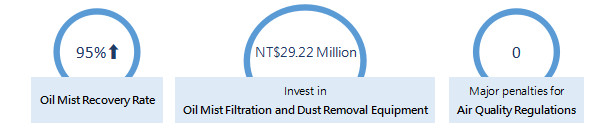
AirTAC's environmental protection efforts adhere to the principles of prevention, integrated prevention and control, and comprehensive management. We implement pollution control throughout the entire production process and enforce pollutant discharge compliance and total emission control. The Company has established plant-level environmental monitoring and inspection management procedures. Inspectors conduct testing of plant emissions in accordance with the required air pollutant indicators, inspection frequencies, and testing standards, and issue corresponding inspection reports.
● Daily environmental monitoring mainly focuses on exhaust gas treatment facilities and includes online monitoring by the Environmental Protection Bureau, regular monitoring conducted by commissioned third-party agencies, and in-house inspections performed by the Environmental, Health and Safety (EHS) team.
● The main types of air pollutants include oil mist exhaust generated from mechanical processing, dust exhaust from sandblasting and polishing, and exhaust from surface treatment processes. These emissions are inspected annually by commissioned third-party agencies to verify the effectiveness of the treatment facilities.
II.Hazardous Substance Management
Toxic substances mainly refer to chromium, acid mist, and other pollutants in exhaust gases, as well as heavy metals such as chromium, nickel, copper, and zinc in wastewater. VOCs are primarily generated from the volatilization of paints, thinners, or solvents used in painting and rubber processing. VOCs are controlled through enclosed operations to reduce emissions, with collected exhaust gases first adsorbed by activated carbon and then decomposed via catalytic oxidation devices.
Emissions of toxic substances are reduced and treated in a harmless manner through exhaust gas treatment equipment and wastewater treatment stations. Monitoring data from the Environmental Protection Bureau's online system, regular inspections by accredited third-party agencies, and internal monitoring by the Environmental, Health, and Safety (EHS) unit all show that emission levels remain well below regulatory standards.

Water Resources and Wastewater Management
AirTAC is committed to protecting and efficiently using water resources by assessing water usage and conservation, as well as monitoring potential water shortages caused by droughts. The Company's manufacturing processes are not classified as high water-consuming processes. In accordance with regulations, the plants obtain permits for water pollution prevention. The main source of wastewater is domestic sewage, which is monitored monthly in-house, with additional inspections conducted by Environmental Protection Administration-accredited laboratories to verify wastewater discharge compliance.
I.Goals and Strategies
AirTAC is committed to addressing water resource issues by continuously conserving water and increasing the proportion of recycled water. The Company sets concrete short, medium, and long-term targets and action plans to reduce overall water consumption.
|
Goals and Strategies |
2024
Performance Achievements |
2026 Goals and Corresponding Strategies |
2036 Goals and Corresponding Strategies |
|
Water Management |
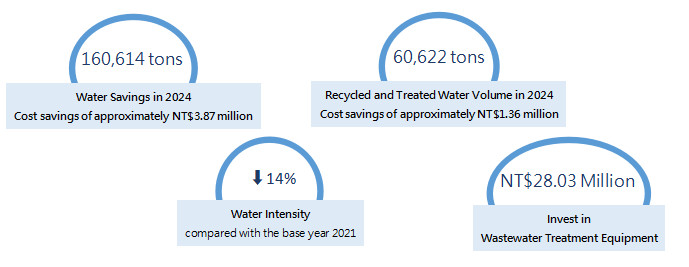
In 2024, AirTAC's water intensity (water consumption per NT$1 million in sales) was 30.63, a 14% reduction from 2021. |
Target:
Compared with 2021, water intensity decreased by 12%. As the target was achieved ahead of schedule in 2024, the goal has been revised upward to 17%. |
Target:
Compared with 2021, water intensity decreased by 25%, |
|
Strategies:
Address water conservation at the source by optimizing production processes and introducing wastewater reduction equipment to minimize water usage. At the same time, implement reclaimed water reuse systems to increase the proportion of recycled water. |
Strategies:
Continuously conserve water by implementing advanced water-saving and treatment technologies to improve water recycling performance. |
II.Water Consumption
AirTAC actively implements water-saving measures, such as installing water-efficient faucets in restrooms, setting up process water recycling equipment, equipping wastewater treatment stations with water recovery systems, reusing mechanical cleaning wastewater in workshop vibration cleaning processes after treatment at the plant's wastewater station, and partially recycling boiler steam condensate back to the boiler room for reuse. These initiatives help conserve and effectively utilize water resources.
Unit: metric ton
|
Items |
AirTAC Taiwan |
AirTAC Ningbo |
AirTAC Guangdong |
AirTAC China |
Total |
|
2021 |
2022 |
2023 |
2024 |
2021 |
2022 |
2023 |
2024 |
2021 |
2022 |
2023 |
2024 |
2021 |
2022 |
2023 |
2024 |
2021 |
2022 |
2023 |
2024 |
|
Total Water Withdrawal
(A) |
76,033 |
87,419 |
62,102 |
63,020 |
688,334 |
741,416 |
771,745 |
724,947 |
62,622 |
67,763 |
79,982 |
71,820 |
30,925 |
15,077 |
18,050 |
18,678 |
857,914 |
911,675 |
931,879 |
878,465 |
|
Water
Recycled
(B) |
3,071 |
3,516 |
4,690 |
6,256 |
42,300 |
44,264 |
45,312 |
50,252 |
4,680 |
3,240 |
4,015 |
4,114 |
- |
- |
- |
- |
50,051 |
51,020 |
54,017 |
60,622 |
|
Recycling
Rate
(B/A) |
4.04% |
4.02% |
7.55% |
9.93% |
6.15% |
5.97% |
5.87% |
6.93% |
7.47% |
4.78% |
5.02% |
5.73% |
- |
- |
- |
- |
5.83% |
5.60% |
5.80% |
6.90% |
|
Total Water
Consumption
(A+B) |
79,104 |
90,935 |
66,792 |
69,276 |
730,634 |
785,680 |
817,057 |
775,199 |
67,302 |
71,003 |
83,997 |
75,934 |
30,925 |
15,077 |
18,050 |
18,678 |
907,965 |
962,695 |
985,896 |
939,087 |
|
Total Water Discharge
(C) |
36,229 |
43,352 |
29,520 |
34,628 |
366,725 |
376,787 |
424,772 |
338,563 |
15,500 |
14,459 |
14,190 |
14,640 |
30,925 |
15,077 |
18,050 |
18,678 |
449,379 |
449,675 |
486,532 |
406,509 |
|
Net Water Consumption
(D=A-C) |
39,804 |
44,067 |
35,582 |
28,392 |
321,609 |
364,629 |
346,973 |
386,384 |
47,122 |
53,304 |
65,792 |
57,180 |
- |
- |
- |
- |
408,535 |
462,000 |
445,347 |
471,956 |
III.Saving Water Program
AirTAC actively promotes water reduction measures and continuously implements various water-saving projects.
Unit: ton
|
Company |
Water Saving Program |
Water Savings in 2024 |
|
AirTAC Taiwan |
Process wastewater recycling |
2,533 |
|
Rainwater harvesting |
3,723 |
|
AirTAC Ningbo |
Landscape water irrigation greening |
5,160 |
|
Boiler condensate recycled and reused |
13,358 |
|
Reverse osmosis (RO) concentrated water reuse |
27,324 |
|
Machine cleaning wastewater reused |
4,410 |
|
Multi-stage counter-current rinsing of surface treatment and cleaning lines |
59,408 |
|
Overflow water control in surface treatment tanks |
101,206 |
|
AirTAC Guangdong |
Machine cleaning wastewater reused |
4,092 |
|
Landscape water irrigation greening |
22 |
|
Total |
221,236 |
IV.Wastewater Management
In 2024, AirTAC invested NT$28.03 million to implement wastewater treatment equipment, aiming to increase wastewater recovery and reduce discharge. All process wastewater generated in AirTAC's production is strictly treated through wastewater recycling systems and meets the regulatory standards in all applicable regions.
● At AirTAC Taiwan, water quality testing is conducted every six months by external professional agencies. The Company has invested in and implemented a process wastewater recycling system to enhance wastewater management practices.
● At AirTAC Ningbo, wastewater is monitored daily for different water quality parameters, including pH, COD, ammonia nitrogen, total phosphorus, total nickel, and hexavalent chromium, according to treatment requirements.
● At AirTAC Guangdong, surface treatment cleaning wastewater is monitored daily, with separate measurements for pH and COD.